

PFAS Remediation
(soils and groundwater)
BIOGENIE Remediation UK Limited has a 30-year track record of successfully developing and implementing remediation technologies in the UK; this includes the first UK air sparge/vapour extraction project, the first large scale implementation of stabilisation/solidification to address heavily organic contaminated soils and the first full-scale electro-kinetic remediation to address metals contaminated groundwater. With the increasing awareness of the extent and risks of PFAS contamination, we have focused our R&D effort over the last two years on site-scale technologies to address PFAS soil contamination and now have three treatment approaches that can be deployed depending on site conditions and the required remedial target values.
These comprise:
- Sorption / stabilisation – sequestration of PFAS into a low leachability / low permeability matrix to limit future entry to controlled waters.Suitable for all soil types where validation against a risk-based leachate, or betterment of leachate performance, is the agreed remediation verification target.
- Washing / segregation – removal of PFAS via washing / foam fractionation with PFAS segregated for off-site disposal / destruction. Suitable for granular soil types where the validation criteria is a soil concentration, leachate concentration or betterment criteria.
- Thermal destruction – catalysed destruction of PFAS compounds using low temperature thermal treatment. Suitable for all soil types where high levels of PFAS removal are required.
Sorption / Stabilisation
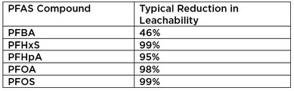
We have adapted our usual soil stabilisation / solidification approach to include sorbents to enhance the sorption of PFAS compounds. This is a similar approach to existing proprietary PFAS soil remediation additives but with much reduced treatment costs for similar or better performance. Reductions in the leachability of PFAS compounds of
>99% are achievable, with better performance for >C6 PFAS compounds making this a particularly suitable approach where PFOA or PFOS are the dominant PFAS compounds. Some typical performance criteria are summarised below:
Washing / Segregation
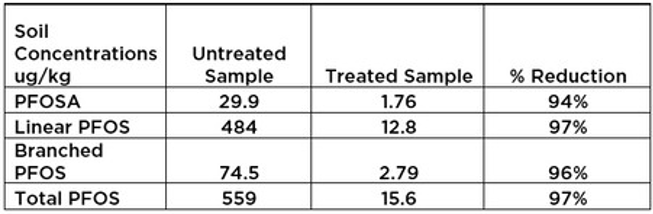
Soil washing had been implemented at full-scale for several European remediation projects, we have adapted the technology by taking learning from other materials processsing industries to achieve enhanced removal of PFAS which can then be sentenced for off-site disposal / destruction. Some typical performance criteria are summerised below:
Thermal Destruction
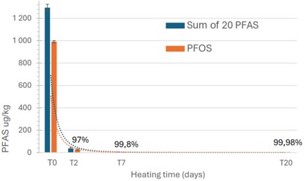
Building on their extensive experience of on-site soil thermal remediation, our parent company has developed a patent-pending, catalysed thermal treatment that achieves a high-level of PFAS destruction at relatively low treatment temperatures and reasonable heating durations. Typically implemented as a batch treatment, the approach is applicable to most soil types where removal of PFAS is a key project requirement. An example of the technology’s performance on a PFAS contaminated site soil is illustrated below.
Next Steps
If you have a PFAS contaminated site and would value a review of the site data to determine potential treatment options, we’d be happy to undertake that for you. Once feasible treatment technologies are shortlisted, we are able to provide bench-scale, proof of concept, trials at our in-house R&D facility to establish treatability and provide post-treatment soil / leachate quality data. The data is presented in a treatability report that places the proposed approach in the context of the conceptual site model, which can be used to support discussions with regulators and inform remediation strategies / remedial options appraisals.
If you’d like further information, we can be contacted at PFAS@biogenie.co.uk

contaminants
- Per- and poly-fluoroalkyl substances (PFAS)
Techniques
- Soil washing
- Stabilisation
- Thermal treatment
- Activated carbon adsorption
- Ion exchange
- Advanced oxidation processes
Selection Criteria
- PFAS concentration and distribution
- Soil and groundwater characteristics
- Regulatory requirements

Unit 8, Commerce Park, Brunel Road, Theale, READING, RG7 4AB
Columbus House, Village Way, Tongwynlais, CARDIFF, CF15 7NE
Chadwick House, Birchwood Park, Risley, WARRINGTON, WA3 6AE
© 2025 Biogenie Remediation UK Limited